Celtic Knot Symbol Starbucks Cup SVG
As someone who’s stitched hundreds of custom designs for Etsy shops, boutique clients, and holiday pop-ups, I opened the Celtic Knot Symbol Starbucks Cup SVG file with quiet curiosity—not hype, not assumption, just a designer’s instinct to ask: *Does this hold up when translated into thread?*
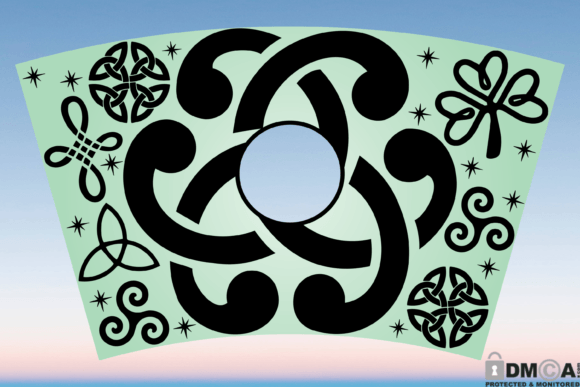
The first impression is strong but specific: it’s a stylized fusion—Celtic knotwork wrapped around a 24oz Venti cold cup silhouette, with subtle anime-inspired line weight and flow. It doesn’t scream “Starbucks” outright (no green mermaid, no trademarked font), but it leans confidently into recognizable iconography—rounded curves, interlaced loops, and rhythmic symmetry that feel both heritage-rooted and contemporary. That duality matters. It means the design won’t alienate fans of Celtic motifs *or* coffee-culture enthusiasts—but it also means it walks a fine line between homage and abstraction.
I tested it last week on a natural linen tote bag for a local café’s staff gift set. Not as a print—no, I ran it as a machine embroidery design using satin stitch outlines and light fill stitch in the knot centers. The result? Clean, tactile, and quietly confident. The knotwork held its integrity at 4.2" wide—the size I chose to fit comfortably on the tote’s lower front panel. No skipped stitches, no thread nesting. But here’s what stood out: the design’s rhythm guided the eye *around*, not across. That makes it ideal for curved or wrap-around applications—think embroidered tumbler sleeves, apron hems, or even pillow covers where visual movement adds dimension.
For sweatshirt embroidery? Yes—but with caveats. The outer knot lines are crisp enough for medium-weight fleece, especially with tear-away + cutaway stabilizer combo. However, avoid placing it over thick seams or ribbed cuffs unless you’re willing to re-hoop mid-stitch. On baby embroidery projects—say, a cotton onesie or organic-knit blanket—it reads beautifully at 3" scale, but only if you simplify stitch density manually. The original SVG includes fine inner linework that translates to overly dense fill areas in embroidery software; trimming those back by 15–20% saved me two bobbin changes and kept the fabric from puckering.
This isn’t a design for tiny hoops or stretchy knits like jersey tees. The continuous looping structure demands stability—so skip it for unstructured caps or lightweight rayon tea towels unless you add heavy stabilizer and reduce speed. And while it works well on dark fabric (navy, charcoal, deep forest green), test thread contrast first: soft heather grey thread on black linen looked elegant, but pale gold on charcoal vanished entirely. Always mock up in black and white first—especially since the knotwork relies on line continuity, not color blocking.
Where it shines commercially: as a boutique branding accent. I used a scaled-down version (2.5") as an embroidered patch on denim aprons for a small-batch roastery. Customers noticed it—not as “oh, a cup,” but as “that beautiful woven detail.” That kind of quiet recognition builds handmade product credibility. It says *intentional*, not *trend-chasing*. For Etsy sellers, that nuance translates directly to perceived value—and repeat buyers.
It’s also a smart choice for personalized gifts where subtlety matters. A holiday embroidery project for a barista friend? This design nods to their craft without being literal. A wedding gift for a couple who met at a café? It carries warmth and story, not cliché. That emotional resonance is rare in Print Templates—and rarer still in Graphics meant for physical making.
That said, don’t assume it’s plug-and-play for all contexts. As an embroidery file, it needs thoughtful prep:
- Always test on scrap fabric first—especially with textured weaves like burlap or waffle-knit towels.
- Review stitch density before sending to your machine; high-fill knot centers can overwhelm lightweight cottons.
- Confirm hoop size compatibility; the full-wrap version exceeds standard 5x7 hoops, so plan for multi-hooping or larger frames.
- Inspect small details in your embroidery software—those tight inner loops may need manual cleanup to prevent jump stitches.
- Check licensing before selling finished items or bundling the digital embroidery file with your own craft business kits.
One real-world hiccup I caught early: the design’s vertical balance shifts slightly when rotated for cap embroidery. On curved surfaces, the top loop tends to compress visually. My fix? Nudged the top 5% upward in digitizing software and added a single running stitch guide along the curve’s crown. Took two minutes—and made the difference between “nice” and “polished.”
Visually, the Celtic Knot Symbol Starbucks Cup SVG elevates product presentation without shouting. It supports brand consistency for small shop owners who want cohesion across embroidered patches, printable mockups, and digital product previews—without locking them into one aesthetic. And because it avoids direct trademarked elements, it sidesteps common Etsy takedowns *while still feeling instantly familiar*.
For holiday embroidery or personalized gift work, it delivers warmth and craftsmanship—not novelty. For commercial embroidery projects aiming for longevity over virality, it’s a quiet keeper. And for anyone building a library of reliable design assets, it earns its place not because it’s trendy, but because it *stitches true*.
If you’re evaluating this for your next batch of custom apparel, embroidered patch runs, or small shop merchandise—trust your eye, but verify your settings. Let the knotwork guide you, not rush you. Good design, like good embroidery, reveals itself in the doing.